
In just a few short weeks, LifeGroups will become the predominant form of community at Bay Hills. And I have to say, it couldn't come any sooner...
We are living through one of the loneliest moments in modern history, even as we are more "connected" than any generation before us. The U.S. Surgeon General has formally declared loneliness a public health epidemic; a 2025 Pew Research survey found that one in six Americans feel lonely or isolated all or most of the time, and a quarter of Americans say they don't have a single person they can confide in. If that wasn't enough, we are now handing people screens instead of one another. A recent Harvard Business Review analysis found that therapy and companionship have become the top reasons people use AI, and a 2024 survey found that 72% of teens have already used an AI companion.
In other words, authentic, embodied, face-to-face community is quietly becoming one of the scarcest resources on earth, and people are so hungry for belonging that they will now seek it from artificial sources.
This is precisely the world Bay Hills has been sent into, and it is exactly why LifeGroups are the future of our church.
So I need to ask something of you before you read on. This article is longer than I usually write, and I did it on purpose. Please don't skim it. Get a cup of coffee, find a quiet chair, and read it slowly. If you call Bay Hills your home, it would be a disservice to yourself to rush through this, because what follows is not a general announcement. It is the direction of our entire church, and the invitation at the end is for all of us.
We are living through one of the loneliest moments in modern history, even as we are more "connected" than any generation before us. The U.S. Surgeon General has formally declared loneliness a public health epidemic; a 2025 Pew Research survey found that one in six Americans feel lonely or isolated all or most of the time, and a quarter of Americans say they don't have a single person they can confide in. If that wasn't enough, we are now handing people screens instead of one another. A recent Harvard Business Review analysis found that therapy and companionship have become the top reasons people use AI, and a 2024 survey found that 72% of teens have already used an AI companion.
In other words, authentic, embodied, face-to-face community is quietly becoming one of the scarcest resources on earth, and people are so hungry for belonging that they will now seek it from artificial sources.
This is precisely the world Bay Hills has been sent into, and it is exactly why LifeGroups are the future of our church.
So I need to ask something of you before you read on. This article is longer than I usually write, and I did it on purpose. Please don't skim it. Get a cup of coffee, find a quiet chair, and read it slowly. If you call Bay Hills your home, it would be a disservice to yourself to rush through this, because what follows is not a general announcement. It is the direction of our entire church, and the invitation at the end is for all of us.
So, What Exactly is a LifeGroup?
A LifeGroup will not be something that Bay Hills offers. A LifeGroup is Bay Hills. That may sound a little dramatic, but I assure you that's not the case. The very composition of Bay Hills, what the church is actually made of, will be LifeGroups.
Bay Hills is not our services. It is not our events. And it is not our new campus, though we thank God for it. Those are all things we do and places we gather, but they are not the thing itself. If the church is the people, and it is, then all of those things are only ever the scaffolding.
The people are the point.
So, if the church is the people, then LifeGroups are the primary way those people actually live out the vast majority of what the New Testament calls us to. Almost everything the Bible pictures the church being and doing happens with people who know your name, not on a crowded Sunday morning. That New Testament vision can be broken down into four traits of a LifeGroup.
Bay Hills is not our services. It is not our events. And it is not our new campus, though we thank God for it. Those are all things we do and places we gather, but they are not the thing itself. If the church is the people, and it is, then all of those things are only ever the scaffolding.
The people are the point.
So, if the church is the people, then LifeGroups are the primary way those people actually live out the vast majority of what the New Testament calls us to. Almost everything the Bible pictures the church being and doing happens with people who know your name, not on a crowded Sunday morning. That New Testament vision can be broken down into four traits of a LifeGroup.
1. A LifeGroup is Where People Can Really Belong
Guests and Members cannot belong to a service, an event, or a building. Those are things people attend, not things people belong to—you can participate in them, but you cannot be a member of them in any meaningful sense. What we are made for is deeper: we are intended to belong to one another. As Paul writes, "in Christ we, though many, form one body, and each member belongs to all the others" (Romans 12:5).
This kind of belonging is what the New Testament calls koinonia—a shared life. It is less like attending a meeting and more like gathering around an open table, where the food, the conversation, and the life itself are held in common. And that table is deliberately open. It is set for both those who already believe and those we hope will believe, because Jesus himself was known for welcoming and eating with the very people others excluded (Luke 15:1–2).
That means our life together will always hold a vast spectrum of people: those mature in faith and those just beginning to investigate, those whose lives are flourishing and those in the middle of struggle, people from shared backgrounds and people from wildly different ones.
It is part of God's beautiful design.
Every time we gather around that table across our differences, we are rehearsing for the day the whole family of God is gathered at the marriage supper of the Lamb (Revelation 19:9), where our belonging will finally be complete.
This kind of belonging is what the New Testament calls koinonia—a shared life. It is less like attending a meeting and more like gathering around an open table, where the food, the conversation, and the life itself are held in common. And that table is deliberately open. It is set for both those who already believe and those we hope will believe, because Jesus himself was known for welcoming and eating with the very people others excluded (Luke 15:1–2).
That means our life together will always hold a vast spectrum of people: those mature in faith and those just beginning to investigate, those whose lives are flourishing and those in the middle of struggle, people from shared backgrounds and people from wildly different ones.
It is part of God's beautiful design.
Every time we gather around that table across our differences, we are rehearsing for the day the whole family of God is gathered at the marriage supper of the Lamb (Revelation 19:9), where our belonging will finally be complete.
2. A LifeGroup is Where People Can Actually Receive Care
The church is not merely invited to care for its people; it is mandated to do so. Paul tells us that in the body of Christ, the members should "have equal concern for each other," so that when one part suffers, every part suffers with it (1 Corinthians 12:25-26). Care is not an optional feature of church life. When we count our guests and members, we find roughly 1,200 souls in our care at Bay Hills. That is a staggering and humbling number. We are woefully under-staffed and under-resourced to ensure that each of those people receives even the basic care they need to face the ordinary trials and troubles of life. Somebody has to have eyes on all of them. A single pastor, or even a small team, simply cannot know the burdens that 1,200 people are carrying day in and day out.
But a LifeGroup can.
When the early church grew too large for the apostles to care for everyone directly, they did not further centralize the work. They distributed it, entrusting the care of the people to a wider circle of trusted, Spirit-filled servants (Acts 6:1-7). We are simply trying to follow that same pattern. By employing a decentralized and thoroughly Biblical approach to care, we can cast a much wider net and multiply our efforts through the LifeGroup network at Bay Hills. Instead of a few people trying to serve everyone, we build a web of people who each faithfully serve a few.
The good news is that most care is not complicated. Most people don't need a professional or a program. They simply need a listening ear and someone who has walked a similar road to speak honestly into their life. Paul reminds us that we comfort others with the same comfort we ourselves have received from God (2 Corinthians 1:3-4). That kind of care can happen in a living room as easily as in an office, and it is exactly what a healthy LifeGroup will attempt to provide.
To be clear, more advanced and specialized care will require its own strategy, and I have already begun laying the groundwork for that part of the plan. But the vast majority of what our people need right now does not require that. We can meet most of their care needs right now, week by week, through LifeGroups and the leaders who love them. We are all called to "carry each other's burdens, and in this way fulfill the law of Christ" (Galatians 6:2), and the LifeGroup is where that will become actually possible.
But a LifeGroup can.
When the early church grew too large for the apostles to care for everyone directly, they did not further centralize the work. They distributed it, entrusting the care of the people to a wider circle of trusted, Spirit-filled servants (Acts 6:1-7). We are simply trying to follow that same pattern. By employing a decentralized and thoroughly Biblical approach to care, we can cast a much wider net and multiply our efforts through the LifeGroup network at Bay Hills. Instead of a few people trying to serve everyone, we build a web of people who each faithfully serve a few.
The good news is that most care is not complicated. Most people don't need a professional or a program. They simply need a listening ear and someone who has walked a similar road to speak honestly into their life. Paul reminds us that we comfort others with the same comfort we ourselves have received from God (2 Corinthians 1:3-4). That kind of care can happen in a living room as easily as in an office, and it is exactly what a healthy LifeGroup will attempt to provide.
To be clear, more advanced and specialized care will require its own strategy, and I have already begun laying the groundwork for that part of the plan. But the vast majority of what our people need right now does not require that. We can meet most of their care needs right now, week by week, through LifeGroups and the leaders who love them. We are all called to "carry each other's burdens, and in this way fulfill the law of Christ" (Galatians 6:2), and the LifeGroup is where that will become actually possible.
3. A LifeGroup is Where People Finally Learn to Live Out Their Faith
Christians today do not have an information problem. They have an integration problem. In most churches, content is no longer scarce. We can access more messages, podcasts, YouTube videos, books, and studies than any generation in history could have dreamed of. What is genuinely scarce is the environment where community is embodied, where we sit close enough to one another to ask how we actually integrate what we have learned into the daily rhythms of real life. As Proverbs puts it, "as iron sharpens iron, so one person sharpens another" (Proverbs 27:17), and that kind of sharpening only happens up close.
Consider the ordinary pattern of a Sunday. Most guests and members arrive each week genuinely eager, hoping to hear a message that might unlock some truth for the pain and pressure points they are facing. And often they do. But by midweek, the message has quietly been forgotten, buried under the noise of their lives, and the following Sunday, the same cycle begins again. It becomes a rhythm of steady information consumption with very little actual integration. James warned us about exactly this: that we can hear the word, then walk away and immediately forget what we heard (James 1:22-24).
Integration happens somewhere else. It happens not merely in hearing the word of truth but in living it out alongside others who are trying to do the same. This is precisely the gap that LifeGroups are designed to fill. They are the venue that stretches us beyond Sunday, because the content will be built to answer a very practical question. "How do we get Sunday's message into Monday's routine?" In other words, what does it actually look like to live this out in our real lives?
LifeGroups also give us room that Sunday morning simply cannot provide, and honestly is not meant to provide. A single message cannot pause to explore how one truth lands differently in a dozen different lives. A LifeGroup, on the other hand, can explore how Sunday's message will shape the tech worker, the refinery worker, and the stay-at-home mom, each of whom will carry that same truth into a very different world. This is the wisdom of teaching "from house to house" that we see in the early church (Acts 20:20), where the word was worked out in the particulars of ordinary lives. In this regard, information becomes not just integration, but transformation.
Consider the ordinary pattern of a Sunday. Most guests and members arrive each week genuinely eager, hoping to hear a message that might unlock some truth for the pain and pressure points they are facing. And often they do. But by midweek, the message has quietly been forgotten, buried under the noise of their lives, and the following Sunday, the same cycle begins again. It becomes a rhythm of steady information consumption with very little actual integration. James warned us about exactly this: that we can hear the word, then walk away and immediately forget what we heard (James 1:22-24).
Integration happens somewhere else. It happens not merely in hearing the word of truth but in living it out alongside others who are trying to do the same. This is precisely the gap that LifeGroups are designed to fill. They are the venue that stretches us beyond Sunday, because the content will be built to answer a very practical question. "How do we get Sunday's message into Monday's routine?" In other words, what does it actually look like to live this out in our real lives?
LifeGroups also give us room that Sunday morning simply cannot provide, and honestly is not meant to provide. A single message cannot pause to explore how one truth lands differently in a dozen different lives. A LifeGroup, on the other hand, can explore how Sunday's message will shape the tech worker, the refinery worker, and the stay-at-home mom, each of whom will carry that same truth into a very different world. This is the wisdom of teaching "from house to house" that we see in the early church (Acts 20:20), where the word was worked out in the particulars of ordinary lives. In this regard, information becomes not just integration, but transformation.
4. A LifeGroup is Where People Can Go Fulfill Their Purpose
The church growth movements of the 80s and 90s gave us much to be thankful for, and much to undo. The attractional mindset it birthed, largely shaped by the boomer generation, quietly and unintentionally outsourced the church's mission to professional clergy, whose main task became convincing everyone else to "come and see." Come and see our services. Come and see our programs. Come and see our events. It was well-intentioned, and God used it, but over time it produced a generation of Christians who assume that more of those things is the cure for their own spiritual apathy. When we feel dry, we consume or attend something else, as though it were the answer to lukewarm faith.
But that was never really what Jesus' mission was about, not completely, anyway. Jesus imagined a completed discipleship arc, one that does not end at "come and see" but matures into "go and tell." His final words to the church were a commission to move! "Go and make disciples of all nations" (Matthew 28:19). The direction of the Christian life is fundamentally outward, with Sunday as the launching point, not the landing point.
What makes this so freeing is that the going is not reserved for experts. It is for everyday people, handed an everyday commission that gives them a genuine everyday purpose in the everyday places they have already been sent to. The places they live, the places they work, and the places they recreate. You do not have to leave your life to join the mission.
Your life is the mission field.
Jesus prayed not that we would be taken out of the world but that we would be sent into it (John 17:15, 18), and that sending includes the ordinary corners of the East Bay where you already spend your week.
Again, the result is that the net is cast wider. Instead of a few professionals carrying the whole load, we multiply our efforts as each person embraces personal responsibility for God's mission to reach "one more." Every believer can reach people no one else can reach: neighbors, coworkers, and friends who are already within arm's length. And they do not go alone. The LifeGroup becomes their platform for ministry, a home base of encouragement, prayer, and shared purpose as we scatter across the East Bay together. This is how the early church turned the world upside down.
They "went everywhere," ordinary people carrying an extraordinary message wherever they were scattered (Acts 8:1, 4).
But that was never really what Jesus' mission was about, not completely, anyway. Jesus imagined a completed discipleship arc, one that does not end at "come and see" but matures into "go and tell." His final words to the church were a commission to move! "Go and make disciples of all nations" (Matthew 28:19). The direction of the Christian life is fundamentally outward, with Sunday as the launching point, not the landing point.
What makes this so freeing is that the going is not reserved for experts. It is for everyday people, handed an everyday commission that gives them a genuine everyday purpose in the everyday places they have already been sent to. The places they live, the places they work, and the places they recreate. You do not have to leave your life to join the mission.
Your life is the mission field.
Jesus prayed not that we would be taken out of the world but that we would be sent into it (John 17:15, 18), and that sending includes the ordinary corners of the East Bay where you already spend your week.
Again, the result is that the net is cast wider. Instead of a few professionals carrying the whole load, we multiply our efforts as each person embraces personal responsibility for God's mission to reach "one more." Every believer can reach people no one else can reach: neighbors, coworkers, and friends who are already within arm's length. And they do not go alone. The LifeGroup becomes their platform for ministry, a home base of encouragement, prayer, and shared purpose as we scatter across the East Bay together. This is how the early church turned the world upside down.
They "went everywhere," ordinary people carrying an extraordinary message wherever they were scattered (Acts 8:1, 4).
So, How is a LifeGroup Any Different Than a Small Group?
Great question! I'm so glad you asked...
First, I want to recognize that there have been so many life-giving Small Groups at Bay Hills, both presently and historically. But just because something is life-giving doesn't mean it's strategic. And just because it was helpful in one season doesn't mean it's helpful in every season. I want to honor what those groups have meant and, at the same time, be hopeful for where God is taking us next.
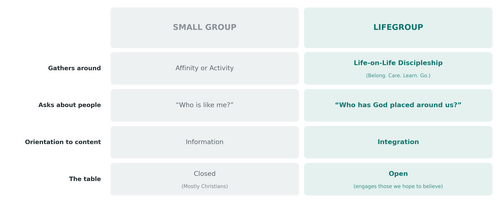
For most of our history, Small Groups at Bay Hills have gathered around one of two things. Either affinity, meaning shared preference or shared type: the women's group, the men's group, the young marrieds, the empty nesters, the folks who like the same kind of content. Or activity, meaning a shared hobby: the board game group, the hiking group, the group that meets to do a particular thing. Real life has happened in those groups, and we should thank God for it. There will even be a place for groups like these in the future.
But notice what they all have in common: uniformity. And uniformity is comfortable, which is why a Small Group can be so appealing. We come together because we are alike, because we enjoy the same thing, or because we want to study the same content. But when the affinity changes or the activity ends, the group grows stagnant or ends all together. Now, let me be clear, that is not a failure, per se. Those groups simply reached their functional ceiling. In other words, they did exactly what they were designed to do.
But, at Bay Hills, in this season, we need our groups to do more.
Which is why a LifeGroup is designed to serve a different function. LifeGroups are neither affinity- nor activity-based. Their focus is life-on-life discipleship, ordinary people helping ordinary people become more like Jesus, up close and over time. And here is the beautiful part: healthy disciples make more disciples. That is simply what discipleship does when it is in its healthiest form. Which means a LifeGroup does not concern itself with uniformity at all. Instead, it centers around a mission that’s enhanced by learning how to live out the church’s overarching message preached on Sundays. By its very design, a LifeGroup becomes inherently mission-driven and message-centered.
This design shift opens door after door for community, growth, and purpose. Because a LifeGroup is driven by a mission rather than an affinity or activity, its table is open rather than closed (Belong). Because it exists to strategically care for others, rather than merely to socialize, it becomes the place your burdens are actually seen and carried (Care). Because it is centered on the message, not just our preferred content, it turns Sunday's truth into Monday's transformation, rather than just one more helping of information we consume and forget (Learn). And because it is sent rather than self-contained, it hands every ordinary person a missional platform into the ordinary places they already live, work, and play (Go).
So here is the best way I can say it: we attend a Small Group, but a LifeGroup does everyday life together in a way that reaches others. A Small Group asks, "Who is like me, and what do we enjoy doing or studying together?" A LifeGroup asks, "Who has God placed around us, how is He growing us, and who is He calling us to reach?" One gathers around preferences and/or content. The other is about a shared life, living out God's mission together.
Both types of groups may sit around a table of sorts, but only one of them is the church learning to actually be the church.
First, I want to recognize that there have been so many life-giving Small Groups at Bay Hills, both presently and historically. But just because something is life-giving doesn't mean it's strategic. And just because it was helpful in one season doesn't mean it's helpful in every season. I want to honor what those groups have meant and, at the same time, be hopeful for where God is taking us next.
For most of our history, Small Groups at Bay Hills have gathered around one of two things. Either affinity, meaning shared preference or shared type: the women's group, the men's group, the young marrieds, the empty nesters, the folks who like the same kind of content. Or activity, meaning a shared hobby: the board game group, the hiking group, the group that meets to do a particular thing. Real life has happened in those groups, and we should thank God for it. There will even be a place for groups like these in the future.
But notice what they all have in common: uniformity. And uniformity is comfortable, which is why a Small Group can be so appealing. We come together because we are alike, because we enjoy the same thing, or because we want to study the same content. But when the affinity changes or the activity ends, the group grows stagnant or ends all together. Now, let me be clear, that is not a failure, per se. Those groups simply reached their functional ceiling. In other words, they did exactly what they were designed to do.
But, at Bay Hills, in this season, we need our groups to do more.
Which is why a LifeGroup is designed to serve a different function. LifeGroups are neither affinity- nor activity-based. Their focus is life-on-life discipleship, ordinary people helping ordinary people become more like Jesus, up close and over time. And here is the beautiful part: healthy disciples make more disciples. That is simply what discipleship does when it is in its healthiest form. Which means a LifeGroup does not concern itself with uniformity at all. Instead, it centers around a mission that’s enhanced by learning how to live out the church’s overarching message preached on Sundays. By its very design, a LifeGroup becomes inherently mission-driven and message-centered.
This design shift opens door after door for community, growth, and purpose. Because a LifeGroup is driven by a mission rather than an affinity or activity, its table is open rather than closed (Belong). Because it exists to strategically care for others, rather than merely to socialize, it becomes the place your burdens are actually seen and carried (Care). Because it is centered on the message, not just our preferred content, it turns Sunday's truth into Monday's transformation, rather than just one more helping of information we consume and forget (Learn). And because it is sent rather than self-contained, it hands every ordinary person a missional platform into the ordinary places they already live, work, and play (Go).
So here is the best way I can say it: we attend a Small Group, but a LifeGroup does everyday life together in a way that reaches others. A Small Group asks, "Who is like me, and what do we enjoy doing or studying together?" A LifeGroup asks, "Who has God placed around us, how is He growing us, and who is He calling us to reach?" One gathers around preferences and/or content. The other is about a shared life, living out God's mission together.
Both types of groups may sit around a table of sorts, but only one of them is the church learning to actually be the church.
So, Why Would I Join a LifeGroup?
Oh, boy. I want to answer this as pastorally as I know how. For years now we have been laying the groundwork for LifeGroups. And it should be clear by now why we believe LifeGroups are the future: they are how we intend to actually be the church. So the question is not really "why would I join a LifeGroup?" The better question, the one I want to gently put in front of you, is this...
Why wouldn't you?
I can think of four potential reasons, and I want you to read them with an honest heart and reflect on each one. Each one lines up with one of the four traits of a LifeGroup.
Why wouldn't you?
I can think of four potential reasons, and I want you to read them with an honest heart and reflect on each one. Each one lines up with one of the four traits of a LifeGroup.
1. Belong. Maybe you prefer a closed table.
Is it possible that you prefer a closed table to an open one? Before you rush to answer, let me explain what I mean. A closed table feels safe. You get to decide who sits down, who gets in, and who stays out. You get to keep your circle curated and your risk low. But there is a subtle danger in that. When you alone decide who your community is, you inevitably shape it in your own image, and a community made in your image can never actually challenge you, comfort you, or grow you the way the family of God is meant to (Ephesians 4:14-16). Jesus set a different kind of table, one deliberately open to people who lived different, thought different, and looked different. It was open to the believer and those we hope to believe alike. This is because community was never meant to be something you manufactured; rather, it was meant to be something God designed for you (Psalm 68:6; 1 Corinthians 12:18). In other words, the community we need is the one God gives us, and it is always better than the one we would have chosen for ourselves.
2. Care. Maybe you don't think you need help.
Perhaps you hesitate because, if you are honest, you don't really think you need the church's care. "I'm fine," you tell yourself (Revelation 3:17). And friend, I say this gently, that is one of the most effective lies that Satan can get you to believe. It is a smokescreen for Western independence and isolation that is crippling our culture. The truth is that none of us are actually built to carry life's burdens alone (Ecclesiastes 4:9-11). But it's not just that. If you believe you have no need of care, you probably also believe you have nothing to offer in return, and that simply is not true, either (1 Peter 4:10). There is someone in a LifeGroup right now who needs exactly what you have walked through. You have a comfort to give that no one else can give (2 Corinthians 1:3–4). You have something to offer, whether that is caring for someone, walking beside them, or at the very least praying for them. To stay away is to withhold a gift from those who need it.
3. Learn. Maybe you prefer information over integration.
Maybe your skepticism is a little more consumer-driven. You're used to choosing your church, your content, and your community. Maybe that's how you would like to keep it. There's something very American about keeping our options open and having the power to choose the content and people we will engage with. But the truth you want to hear may not be the truth you need to hear. We have all grown used to curating our own spiritual intake, skipping what convicts us and leaning into what our itching ears want to hear (2 Timothy 4:3). And if we are honest, that means we are really only after more information, and we have quietly made peace with little to no actual transformation (James 1:22). A LifeGroup intends to interrupt that and maybe that scares you. It scares you because it puts you in a room where mere Bible knowdlege is no longer the point; rather the Word gets lived, tested, and worked out loud with others. Yikes! But, friend, that is where the Bible finally becomes living and active (Hebrews 4:12). And that's how we're going to become more like Jesus...together.
4. Go. Maybe fear or ego is holding you back.
Lastly, it could be that underneath it all, it is either fear or ego that keeps you from embracing a LifeGroup. Especially when it comes to the idea of seeing yourself as an everyday missionary. Fear whispers that you are not equipped, not spiritual enough, not ready. Maybe it's just fear of rejection that prevents you from living out your faith in front of those we hope to believe one day (2 Timothy 1:7). Or, maybe it's ego. Ego whispers a different lie: that this is really the job of the professionals, the pastors and others on the team. I have neither the time nor the desire for this! You believe that your primary, Christian purpose can be safely outsourced to others. All of these are lies that leave the harvest untended (Matthew 9:37-38). You have a bigger part to play than you think or admit. You can reach people that no pastor of ours will ever be able to: neighbors, coworkers, and friends in your sphere of influence. So it may be of some comfort to know that you are not being asked to go alone. The people in your LifeGroup would be right there to support you, equip you, and go with you.
A Hopeful Invitation
Here is what I suspect is true for many of us. Beneath the busyness and the routines of a normal everyday life, there is a quiet ache in the soul that keeps whispering the same thing: there has to be something more than this. More than showing up on Sunday and slipping out before the last song. More than a faith you mostly practice alone. More than information you collect and nod along to but never quite live out.
You feel this way not because something is wrong with you. It may be the gentle nudging of the Holy Spirit who wants more for you, as well. You were not made to casually observe the Christian life from a safe distance. You were made to belong, to be cared for and to care for others, to be transformed and not merely informed, and to be sent with a purpose bigger than yourself. None of this is intended to lead to more effort, but more life.
And a LifeGroup, imperfect and ordinary as it is, is simply where we have decided to go looking for more life together.
I want to close not by pressuring you or selling you, but with an invitation, maybe even a dare. There is one place in all of the Bible where God actually invites us to test him. He says, "Test me in this... and see if I will not throw open the floodgates of heaven and pour out so much blessing that there will not be room enough to store it" (Malachi 3:10).
I want to extend that same invitation to you, on behalf of God and, humbly, on behalf of Bay Hills. Put us to the test. Join a LifeGroup, give it your honest effort for a season, and see what God does. I am not asking you to attend one more thing. I am asking you to step into the very thing the church actually is. Because, again, a LifeGroup is not something Bay Hills is offering you. A LifeGroup is Bay Hills itself. It is the church.
And there is a seat at the table with your name on it.
PAC
(LifeGroup Sign-Ups Begin Sunday, August 30 at Bay Hills)
You feel this way not because something is wrong with you. It may be the gentle nudging of the Holy Spirit who wants more for you, as well. You were not made to casually observe the Christian life from a safe distance. You were made to belong, to be cared for and to care for others, to be transformed and not merely informed, and to be sent with a purpose bigger than yourself. None of this is intended to lead to more effort, but more life.
And a LifeGroup, imperfect and ordinary as it is, is simply where we have decided to go looking for more life together.
I want to close not by pressuring you or selling you, but with an invitation, maybe even a dare. There is one place in all of the Bible where God actually invites us to test him. He says, "Test me in this... and see if I will not throw open the floodgates of heaven and pour out so much blessing that there will not be room enough to store it" (Malachi 3:10).
I want to extend that same invitation to you, on behalf of God and, humbly, on behalf of Bay Hills. Put us to the test. Join a LifeGroup, give it your honest effort for a season, and see what God does. I am not asking you to attend one more thing. I am asking you to step into the very thing the church actually is. Because, again, a LifeGroup is not something Bay Hills is offering you. A LifeGroup is Bay Hills itself. It is the church.
And there is a seat at the table with your name on it.
PAC
(LifeGroup Sign-Ups Begin Sunday, August 30 at Bay Hills)
Recent
What is a LifeGroup and Why is it the Future?
August 13th, 2026
What the Bible Actually Says about the Gift of Tongues
June 17th, 2026
Christian Scandals, Political Rage, and the Slow Erosion of Our Credibility
January 13th, 2026
This Year Could Be Your Hardest Ever
December 29th, 2025
A Tale of Two Churches: 2025 Year in Review
December 26th, 2025
Archive
2026
2025
March
2024
September
2023
November
2022
November
December
5 Comments
The epitome of WWJD ?
May it be so…
Excellent information, praise Lord. I will definitely join the life group. God bless all that involved in this ministry. Amen
I pray that we all walk through that door and come together. May we has a family reach others that crave this type of community.
This really resonated with me. I especially appreciate the reminder that church is more than attending on Sundays—it’s about truly doing life together. I’m excited to see how LifeGroups help us build stronger relationships, care for one another, and grow together in our faith.
n